Yamas and Niyamas- Bicycle Style


bicycle at Fisherman's Terminal

shifting light & changing gears

The quality of light has shifted in the past couple of weeks, reminding me that summer is coming to an end soon. There are fewer birds in the trees on my morning bike ride and the geese that I’ve witnessed turn from chartreuse gosling to awkward adolescent have finally made it to full-fledged goose.  I’ve planted winter crops in the p-patch, begun to empty my closet of summer wear and pulled out my socks and boots in preparation for fall and winter. And just as the trees are beginning to change color, my wardrobe is beginning to move back toward my basic black.

Usually this time of year makes me a bit wistful about what I’ve missed out on during the long, lazy days of summer, but with the overwhelming events of the summer, I’m feeling ready to hunker down for the dark days. That is, except for my bike commute to work…I’ve been riding my bike to work regularly since early spring of this year, and I’m not quite used to riding in the dark or the rain. I’ll be damned if I’ll be a fair weather rider again, and so I wanted to inspire myself to take my cycling journey more seriously. I realized I needed to pull out the big guns. I decided to look at my cycling through a yogic lens of the Yamas and Niyamas.

my journey of bicycle riding through the first two limbs of Patanjali’s eight limbs of yoga

Yamas: Moral principles and social behaviors (some call these the “restraints”). If followed, these five precepts can help anyone to find balance- which is always good when one is riding a bike.

  • Ahimsa (Non-Violence):  Donna Farhi describes Ahimsa as “a state of living free from fear”, which is the perfect reminder for my bicycle riding. It’s impossible for me to ride a bike without experiencing some amount of healthy fear, but I can’t allow this to impact the entire experience. I have to trust that I will not necessarily fly over my handlebars or be slammed into by a texting driver. As regularly as riding a bike brings me in touch with my mortality, I have to understand that nobody is out to hurt me intentionally. And riding a bike subsequently causes less harm to the planet than my driving a car- which makes me (and my body) happy.
  • Satya (Truthfulness): Honesty is moral and good, and so is following rules. So, to be completely truthful here, there are times when I run red lights or blow through stop signs on my bike (like at 5:40 in the morning when there’s no traffic at all). The important thing is to have a commitment to being an upright person in thought, action and speech. This means being honest with myself and others as well as living as impeccably as I possibly can. Sort of like confession- I speak my truth to you about being a morning stop sign runner and now I am forgiven (ok…not really).
  • Asteya (Non-Stealing): Asteya has as much to do with not taking from others as it does not stealing from ourselves. It could relate to not cutting someone off or riding too close- stealing space. It can also be an opportunity to practice being generous- welcoming another biker to take the lead, offering assistance to someone who is broken down or offering up an extra bike to someone who needs one (this is really generous and builds up positive biking karma).
  • Brahmacharya (Celibacy/ Self Control): It’s important to hold back sometimes to conserve some much needed energy and to notice the small things that might have seemed insignificant before. If we’re only going full speed ahead searching for that biking orgasm, we aren’t going to notice the little thrills along the way. And isn’t noticing the small sensory details one of the best things about biking?
  • Aparigraha (Non-Grasping): Be here now. This moment matters, and if you’re grasping onto what just happened or where you need to get to, you’re potentially missing out. You’re also likely distracted from paying attention to things like cars, other bikers, pedestrians, rodents, potholes, etc.  Another perspective is this: riding a bike is just about riding a bike. All of the gear in the world doesn’t take that away. Your bike just needs to get you from point A to point B. Everything else, my gear-head friends, is icing on the bicycle cake. I may want the Linus bike, but do I really need it? Probably not (but don’t tell Santa…).

Niyamas: Personal observances that focus on inner discipline and responsibility (connecting with the self) in order to cultivate a connection to the Whole.

  • Shaucha (Cleanliness): Wash up, people. And that means not only your body but your mind, too. Clutter creates chaos, so it’s just as important to clear your mind as it is to clean out that pannier. I like to take a few minutes before getting on my bike to think about my ride and to prepare for entering the world. If I have everything ready the night before, I have the time to setting before setting out in the world.  That way, my ride itself can be meditative. And that’s really a lovely experience.
  • Santosha (Contentment): Contentment doesn’t mean “happy”. It means equanimity- not placing “good” or “bad” on the situation. Traffic is just traffic. Rain is just rain. Sunshine is just sunshine. A flat tire is just flat. And all of this shall pass- the good, the bad and the ugly.
  • Tapas (Fire/Austerity): The amount of energy you put into anything is what you’ll get out of it. I like to think about the idea of alchemy: burning away those things that don’t matter to make room for the things that do. Riding my bike at the end of the day allows me to forget the things that I was freaking out about just minutes before (refer back to Santosha). It also helps me to decide what it is I want to spend my energy and attention on.
  • Svadhyaya (Self-Study): Svadhyaya refers most specifically to study of scripture and ancient texts. In bicycling, this doesn’t exist as far as I know- but might I suggest reading Pedal, Stretch, Breathe by Kelli Refer. It’s a small little book that takes up very little space and costs just a few bucks. It’s sweet and honest and has incredibly simple suggestions for ways to move your body before, during and after riding. And if this doesn’t appeal to you, I would propose that most spiritual texts are meant for you to take the teachings into the world- why not read the Bhagavad Gita and explore the ways riding a bike in the city can make you feel a bit like Arjuna preparing for a battle (and then go deeper into the concept of dharma, morals, ethics and spiritual connection).
  • Ishvarapranidhana (Devotion): When I open up my heart to God, the Divine, that which is greater than me, I see the world with new eyes. My ride becomes less about where I am going and more about the experience of being connected with everything around me. I develop a greater peace and I soften to the subtleties that occur when I’m on my bike.  I notice my heart beat, the resonance of the birds along the canal, the rhythm of the tires on the pavement and the sound of other bikers breathing as they pedal to pass me. When I pay attention, my interconnectedness with everything feels like a great comfort- and this is really what draws me to riding my bike in the first place.

are you there, God? it’s me…

In memory of Patsy, who lived, loved, laughed and graced the world with a generous heart.

How to find God when nobody’s looking

I’m not a religious person. Not in a structured way, at least. Organized religion sort of freaks me out and makes me wince- most likely because I wasn’t raised going to church and because the first time I remember setting foot in a church, it was as a young teen. I think I was fourteen years old when I sat in an old stone church next to my mom for the memorial service of my brother’s best friend Billy who died of leukemia. Between moments of glaring at my mother for blowing her nose in public (I was a terrible, terrible child), I rolled my eyes at the words of the priest. Seriously, I thought, this is nonsense. Billy is gone, and now the priest is asking for us to give ourselves over to the “Lord”, too? Whatever (did I say it was the 80’s?). I was not going to give anything over to anyone– this “Lord” already had my grandpa and now he had Billy. He sure didn’t need my ass. Consequently, I went on with my angry teenage years having insignificant associations with religion (going to forbidding youth group meetings with a friend, hanging out with pot smoking Mormon missionaries with another friend, and perusing the “New Age” sections at the far corner of the used book store).

Organized religion confused me. God, on the other hand, was someone who I connected with. I can remember pretty regular occasions when I would step outside to stare at the night sky, thinking that stars had to have something to do with heaven or the divine or God or something miraculous, and I would talk out loud. I don’t know that this was prayer- it was more like a one-sided conversation with someone I knew wouldn’t interrupt or judge. It felt safe and sweet, and if I kept this all to myself, nobody could tell me anything about my version of God that would taint my own image. I didn’t want to be confined by anyone else’s ideals and I certainly didn’t want to be told what to do or how to think (still don’t, in case anyone’s wondering).

Although church felt like foreign territory to me, God didn’t feel like a stranger. We didn’t necessarily discuss God or faith outright in my home growing up, but I remember distinctly sitting with my mom as she read Bible stories or singing Sunday school songs for long stretches of road inside the family van. I ended up knowing as many songs as some of my Christian friends, in fact. And I think these times helped me to understand a relationship to something larger than myself or the material world. They informed my way of connecting to people, places, and things.

I found my connection to God most often in nature. Nobody told me to look there, but I had a sense that this was the right place (I have to admit that I may have also been influenced by Laura Ingalls Wilder…). Even now, I feel harmony when I’m outside noticing the small miracles that occur in the natural world. Maybe it’s because I’m less distracted and my mind isn’t racing, and maybe it’s because I’m most at peace away from the confines of a structure (another reason I’m put off from attending church).

Stop trying so hard…

My current image of God has shifted some, and in many ways expanded. I’ve softened and grown and I’m more willing to accept that I don’t have the answers. I suspect that there are few who do, in fact. And that idea comforts me somehow. I’m willing to be open to the unknown and to seek miracles or meaning in the small things. And that helps. Especially when things are difficult.

I have opened to a more fluid image of the sacred, and this has allowed my own compassion to expand and my own meaning of faith to be more of a working one. I can find the sacred in everything from the early morning chickadees at the bird feeder as much as I can watching the interaction between a homeless man and his dog. I can also recognize that my own actions are sacred- a good reminder as a human being. And when I remember this, I wake up a little more and notice things that were previously hidden. Hafiz puts it best:

Now is the time to remember that all you do is sacred.

In Patanjali’s second limb of yoga, the concept of Ishvara Pranidhana (devotion and, ultimately, surrender to God/the Divine) speaks directly to the practice of devotion in order to cultivate awareness. Devotion, in other words, allows the individual to be more awake and aware, experiencing the most subtle levels of living. I like this concept so much- mostly because it reminds me that I am connected to everything and that everything is a part of this whole. Even the things I cringe at or judge. A good reminder when some idiot (a divine idiot, but an idiot just the same) cuts me off in traffic or blows cigarette smoke in my face as I’m walking down the street. These, too, are sacred. It’s not possible to separate them (remind me of this at election time).

Hail Mary’s, Mantras, and Metaphor

Most recently, I found myself looking for God in the hospital where someone I love very much was dying and struggling with pain. I was in the stark hospital room with my partner, taking turns sleeping so that we could be present if anything happened that needed our attention. I was drinking hospital coffee like a mad woman in an attempt to stay awake and gazing at the bed praying for peace, comfort, and healing- whatever that might mean. I stared at our loved one’s rosary beads, read Catholic prayers and poetry aloud, and practiced every calming technique I could think of to sooth my fears (and coffee jitters). I attempted to memorize the Hail Mary, thinking that this prayer could be my mantra and the ultimate gift to my devout friend. What I found, though, was that all of my prayers turned into grasping, and that the most helpful thing that I could do for myself and for my sweet friend was to live my yoga and surrender.

By “surrender”, I don’t mean that I gave up or stopped paying attention. I stopped trying so hard to control the situation. I surrendered to the moment and to my lack of control of it. Letting go allowed me to see everything in a more generous way and it allowed me to be more present for my loved one. The more I grasped and looked for God, the more I stressed out about not being in control. The more I let go, the more open I was to the Divine, and the more I felt connected and engaged in the experience. Sort of like those Chinese finger traps where the harder the person pulls, the stronger the grasp.  The trap only releases when the person softens and stops pulling. A beautiful metaphor.

Just like the trap, my practice of yoga has helped me to notice the times I try too hard in my life (on and off the mat). Sitting in a chair in a tight space between the hospital bed and the radiator was the perfect place to practice living my yoga- to connect to my breath and to surrender. Stop trying so hard and just love, I reminded myself. Everything else comes into place. No balancing required.

Our loved one died the next day. The ultimate act of surrender.

Driving to the airport after a week of memorial and Catholic rituals (and a few whiskey sours), we stopped at a roadside shrine with the Virgin Mary standing regally in the center of a cavernous stone structure. I was reminded about the force of history and the power of faith and devotion. After standing in awe for several minutes, we lit candles in memory and focused on this image of a woman who has represented grace, love and strength from adversity for centuries. My eyes filled with tears, and I recited the Hail Mary in my head, thinking about surrender. We had a long journey toward home ahead, and yet in the act of surrendering, I felt a sense of arrival.

yoga teacher- know thyself as eternal student.

Image
silly yogi on a log- photo by Reen

Teaching yoga may not have made me a better teacher, but it has certainly made me a better student. I know quite certainly that through my limited stint of teaching yoga I have not become the calm, intelligent, confident teacher that I’d hoped to be, but as a student I’ve grown far more patient, kind and engaged.  The yoga student that I am now, post teacher training, practicum and a couple of months of teaching yoga to the general public, is far more likely to give a fellow teacher a second chance before moving on to another class. There’s really nothing, aside from freaky yoga voice or attempts to force me to do something my body (and/or mind) refuses to do, that would make me completely repulsed by a yoga teacher. My yoga student mind is open and full of compassion.

It’s really not too far removed from why I’m so nice to servers at restaurants and why I not only put the sheets in piles on the floor in the hotel, but leave a tip on the table. I understand all too personally just how challenging it is to work in the service industry. In fact, I firmly believe that everyone should have to work service jobs before judging anyone in those positions.

yoga teachers aren’t just in it for the karma, people.

And teaching yoga is ultimately a service industry job. Even in the event that the teacher is not receiving payment for the service, there’s often an expectation that is created that the person who is teaching is the one in charge of creating the entire guided yoga experience. And if it’s a bad experience, it’s most often blamed on the teacher. If someone has an injury in class, it’s most often blamed on the teacher. And if the class sucks big time, it’s most certainly on the teacher to take full responsibility….not that the blame is actually verbalized to the teacher. In most cases, there are just down-turned eyes and students rushing out of the room as if we just had a dirty affair in a mutual friend’s coat closet during a cocktail party. I feel so dirty and confused.

It’s no wonder that before teaching a yoga class, I experience all kinds of fears and anxieties. I know this isn’t very “yogic” (add that one to the “reasons why I’m un-yogic” list), but I have a tendency to prepare for teaching in much the same way I do a dinner gathering- plan, worry, over -think, reconcile to being freaky/ nerdy/ unpopular/ imperfect, experience all sorts of interesting mind/ body shifts, and then forget every single thing the second I step into the room to begin. And it’s a vicious cycle that I can’t seem to break despite meditating, putting  Bach’s Rescue Remedy under my tongue, or breathing in my worry and exhaling my peace (and vice versa).

Let’s be honest- there are times when I’m standing in the front of the class when my mind goes blank, I attempt to read the blank expressions on the students in the room, I wonder who the hell I am to be “teaching” anything, or I begin chuckling at the seriously silly situation we’re all in together. Because yoga class is funny, people. I didn’t know that fact so intimately until I went to the land of yoga Oz and what was behind the curtain was revealed. There is no Wizard (sorry, Bikram). There are just humble and not-so-humble folk who are offering a bit of their own take on an ancient practice. Some are better at doing that than others- and some take it more seriously (I’m not one of those people).

And despite the pre-class anxiety, the teaching guffaws and the post class fears of unworthiness,  I do love teaching yoga- once people have arrived and I know the crowd (or lack thereof) that I’m working with, I can most often take a deep breath and dive in. I’m beginning to find my voice and to recognize that I don’t have to be anyone other than me. In fact, I’m better off when I utilize my own personality rather than trying to imposter a perceived yogi persona (didn’t the Wizard learn that, too?). I have to trust that teaching yoga is not a job but a personal journey- and my walking shoes are waiting for me at the studio door (sorry- no ruby slippers….).

Image

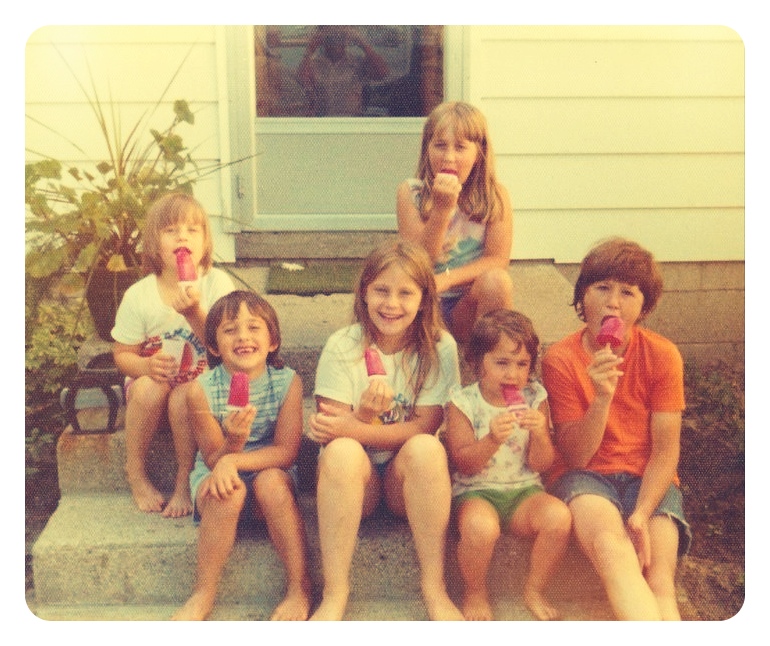
fuel for nostalgia


popsicles on the porch circa ~1978

it all started at the gas pump

Today I watched a disheveled young boy and his younger-looking tomboy of a sister fighting over who could wash the dirty rear window in their dad’s station wagon. Even from behind the gas pump, I could tell that the boy had the idea first, but that he was overtaken by his sister’s enthusiasm and desire to show him up. They struggled for under a minute, grunting, tugging and whining inaudible words at one another while the father stood at the side of the car pumping gas and smiling in apparent amusement. The brother lost the battle rather quickly, standing with his hands in the pockets of his wrinkled pants, looking down at his shoes in disbelief. He gazed up to catch me staring directly at him, recognizing a moment not too long ago when I looked up to my older brother and sister and did everything possible to prove my worth as an equal.

I looked away from the scene, thinking that everything from the grungy outfits to the older model vehicle and scruffy looking dad seemed familiar in the way that made my gut ache and tears well up. It all made me miss home and family and youth; the long, idle days of summer when the most important thing seemed to be driving my older brother crazy while begging for any bit of time from my way too cool for school sister. And look at us now. Too busy with our own lives and families to worry about what the others are doing and waiting for the next obligatory holiday or birthday to reach out with a text or the all too rare phone call.

Standing there at the gas pump with my keys dangling in my hands and my debit card firmly gripped between my lips, I had a major case of nostalgia for my youth. I missed waking up at dawn to scramble toward the beat-up green Suburban in hopes of sitting in the front seat next to my dad as we took to the road in search of the perfect lake for a day of fishing. I pined for the lazy summer days when all I did was lay around reading library books and avoiding my chores of weeding the vegetable garden and dusting furniture. I longed for the days of lounging with my cousins on the front porch of my grandparent’s farmhouse with homemade popsicles dripping from our sticky fingers. I even missed the hot summer days spent sweating in the bright green and yellow kitchen as my mom and grandmother gossiped and giggled over the stove and directed us children in preparatory tasks for canning our fruit bounty.

When did life get so busy and complicated? How did I move into this phase of multitasking and overbooking my life into the next decade?  I so often forget the fact that life is fleeting and fragile, and I wrongly believe all too often that people, places and things will stay the same while I truck on. Unfortunately, this is all too untrue, and everything continues to change to the point of my own image in the mirror reflecting as strange and perplexing. Everything changes. Nothing stays the same.

Purnam: take away the Whole from the Whole, the Whole remains

Everything changes except, perhaps, the divine spark from within that connects the Infinite/Whole. The idea that everything, even those apparently scraggly broken parts, is connected as a part of the whole and is perfect. It all makes me think of the idea of Purnam: wholeness, completeness and ultimate perfection. I am all that came before me, everyone who I have ever encountered, everyone I will ever encounter, the people, places, and things I know and don’t know, and nothing all at the same time. I am whole with and without all of these people, places and things, and beyond my ego, desires, flaws, memories, innate goodness etc., I am connected to all and therefore irrelevant and relevant simultaneously. I find this concept equally perplexing and comforting.

The verse that I learned at yoga teacher training that I continue to work with in my own practice stems from the Santi Mantra of the Brihadaranyaka Upanishad (translation by one of my teachers, Stephanie Sisson):

Purnamadah Purnamidam
Purnat Purnamudachyate
Purnasya Purnamadaya
Purnamevavashishyate

That is Whole, this is the Whole;
From the Whole, the Whole arises;
Taking away the Whole from the Whole
The Whole remains.

In a nutshell: everything changes, yes. Our experiences in these bodies and this life experience are finite; and yet, according to this theory/mantra/teaching, we are all part of the infinite Whole. The messy little girl that I was with scabby knees, uncombed hair and a propensity for dramatic shifts in mood continues to be a part of my own Wholeness which is a part of your Wholeness and the Divine Wholeness. My desire to grasp onto the source of my “me-ness” is merely my own human desire to connect to the Whole, when in reality I am larger and more immense than my memories or even this very body. We all are. Which makes us all that much more fascinating, really.

Metaphorically, our lives are like compost- all the moments and connections contributing to the fertile beings we inhabit right now. And we have a choice. We can be fertilizer, flowers, edible little veggies or blossoming trees, or we could be empty plots of space. We can represent growth and goodness, adding to the oxygen that we all breathe and the nurturing that we all need or we can choose chaos or stagnancy or anything in-between. Because no matter what we do, it’s impossible not to have an impact on someone or something, but we can choose the type of impact and the type of connection we have to the Whole.

Through all the sorrows and sufferings of life,
This message of the sages glows bright
In my heart:
‘The Immortal Being manifests himself in Joy.’
To prove the contrary is nothing but empty cleverness,
Trying to belittle the Great.
He who sees Supreme Truth
Beyond Time and Space, in its entirety-
For him alone has life a meaning.

~Rabindranath Tagore

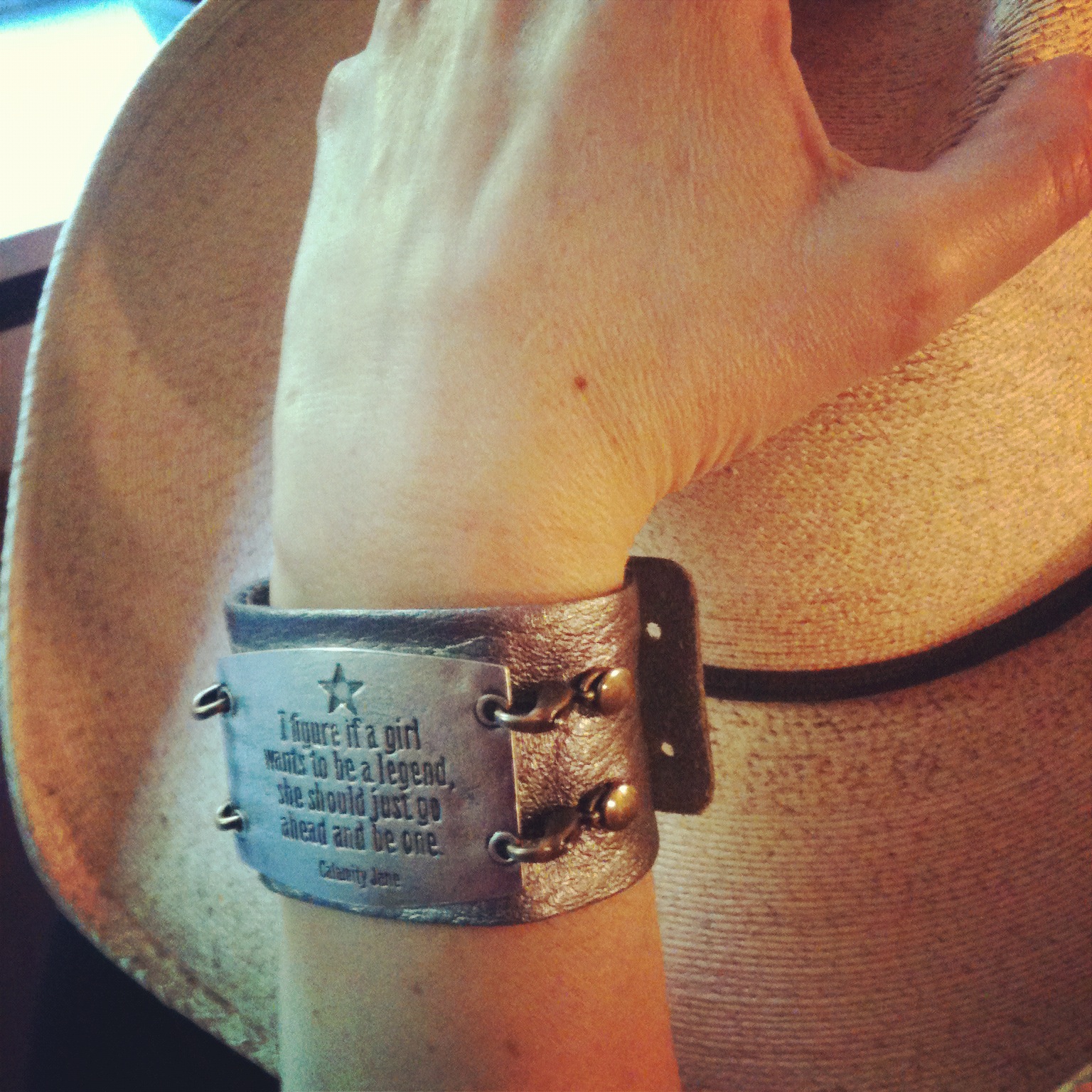
go ahead. be a legend.

photo by Reen

I figure if a girl wants to be a legend,
she should just go ahead and be one.
~ Calamity Jane

I was bestowed with a bracelet for my birthday that has the above quote by Calamity Jane prominently stamped across the top. It’s a silver mix of leather and metal and it’s sassy as all get out. I love this bracelet so much, and not only because someone went out of their way to make sure that I have said wristlet or because it looks kick ass (which it does), but because it serves as a reminder to me that I am in charge of my own destiny. I could pretend that everything in my life is out of my control (which, admittedly, many things are), or I could recognize that I have direct influence over the one thing that matters when in comes to my destiny: choice.

It’s true that I can’t control many of the external situations in my life, but I have choice about how I respond to them through my thoughts, speech, or actions. As much as I hate to admit this sometimes, I have the most direct influence in how my life is going to be. I could be a lover or a hater. And that’s the truth.

I could also choose to be a legend in my own right.

And I do have aspirations for greatness. When it comes right down to it, I want to be someone I can feel good about- and that includes everything from daily acts of kindness to working for social services that I believe in. It includes being righteous when there’s a cause worth taking a stand for, and not feeling compelled to follow the masses just because it’s comfortable or easy. Being a legend means sometimes taking the uncomfortable or unpopular path and recognizing that the only compass available is your gut.

Maybe Calamity Jane isn’t the best role model, but she was indeed a legend– and she was a woman ahead of her time. I admire her tenacity, her spunk, and her willingness to be an original. I’m not planning to take up firearms or to begin a daily whiskey habit (note that I said daily) any time soon, but I do fully intend on living my own dharma and packing my own metaphorical pistol of truth along for the journey. I am bound for greatness.

So, of course, I made a list of inspirations for how to live like a legend:

  • Generate tapas/fire/energy through work and activities that inspire and engage you.
  • Be fierce in your love, faith, beliefs and allow them to guide you.
  • Laugh at yourself (loudly) and cry in messy ways. Allow someone else to clean up the mess.
  • Fight for a cause you believe in, stick to your guns, and wear something outrageous every now and then just because you want to stick out as the unique and fabulous individual that you are (because legends usually have a style all their own).
  • Stop: playing like you’re not a miracle, being smaller than you are, or seeking forgiveness for the things you don’t really feel sorry for. Also- pack away anything in your wardrobe that makes you uncomfortable or that bores you out of your mind.
  • Start: speaking your truth (even if that means dropping the “f” bomb in yoga class), valuing yourself, and making room for greatness.

Lastly, forget the lists (including the one above) or the plans or the “could/should” ideas lurking in your head and just live from your heart. Trust your intuition and live fully. Be legendary.